
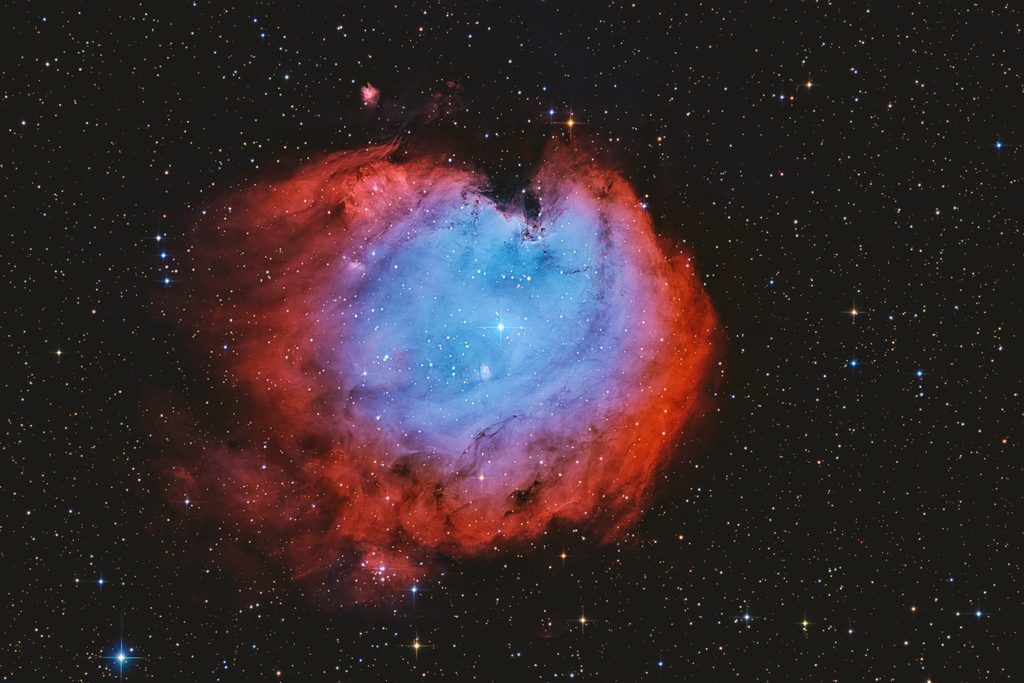
A vast cloud of gas and dust in Orion where new stars are forming. The glow comes from hot young stars within the nebula that energize the gas, giving us red from hydrogen and bluish tones from oxygen. Its shape looks like a monkey’s face, which is why it is called the Monkey Head.
EQUIPMENT USED
🔭 Skywatcher 200 PDS F5 (200/1000) Telescope
📷 ZWO ASI2600MM Pro Camera
⚙️ Skywatcher EQ-6R Pro Mount
⚫ Antlia 36mm LRGB-V Pro series and 3nm H & O Pro series
🔭 ZWO OAG-L
📷 ZWO ASI220MM Guide-camera
🎯 ZWO Electronic Auto Focuser
🎡 ZWO 7×36 Electronic Filter Wheel
💻 Skull Saints Carbon Mini-PC
🔌 Pegasus Powerbox Micro
CAPTURE DETAILS
🔴 Hydrogen: 5 min × 89 frames (7 hrs 25 mins)
🔵 Oxygen III: 5 min × 77 frames (6 hrs 25 mins)
⚪ Luminance: 3 min × 63 frames (3 hrs 9 mins)
🔴 Red: 2 min × 35 frames (70 mins)
🟢 Green: 2 min × 30 frames (60 mins)
🔵 Blue: 2 min × 30 frames (60 mins)
⚫ 20 Darks for each exposure
⚪ 20 Flats for each filter
⚫ Flat-Darks for each Flat set
🔊 Gain: 0
🕑 Total integration time:
Ha + OIII + L + RGB = 1206 min
= 20 hr 6 min total integration
🌡Sensor Temperature: 0 Degrees
Location: Mandal, Gujarat
Sky Bortle Scale: 5
Weather Condition: Slightly Hazy
SOFTWARE USED
Image Acquisition: N.I.N.A
Guiding: PHD2
Planetarium: N.I.N.A
Polar Alignment: Polemaster
Mount Control: EQMOD
Pre-processing: Pixinsight
Post-processing: Pixinsight and Photoshop
ACCESSORIES USED
Polemaster Camera for Polar Alignment
Lenovo P-12 Tablet
Portronics Keyboard and Mouse
A3 Illuminated drawing board for capturing Flats

Leave a Reply