

I am an astrophotographer and an avid visual observer. I take out my telescopes for two purposes: either to spend the night observing through them or to photograph celestial objects.
And mind you, both have their own beautiful experiences.
When I am out with my telescope for an observing session, I generally start late, when all the house lights have been turned off and human activity is at its lowest. There are fewer cars on the roads, which means fewer chances of someone accidentally flashing their headlights in my face or stopping by just to have a chat.
I am not antisocial, but I like spending my nights alone with my telescope, accompanied by a small chair and a few protein bars to keep me awake.
The reason is simple: I want to completely immerse myself in the beauty of the night sky, without anything else taking my attention away.
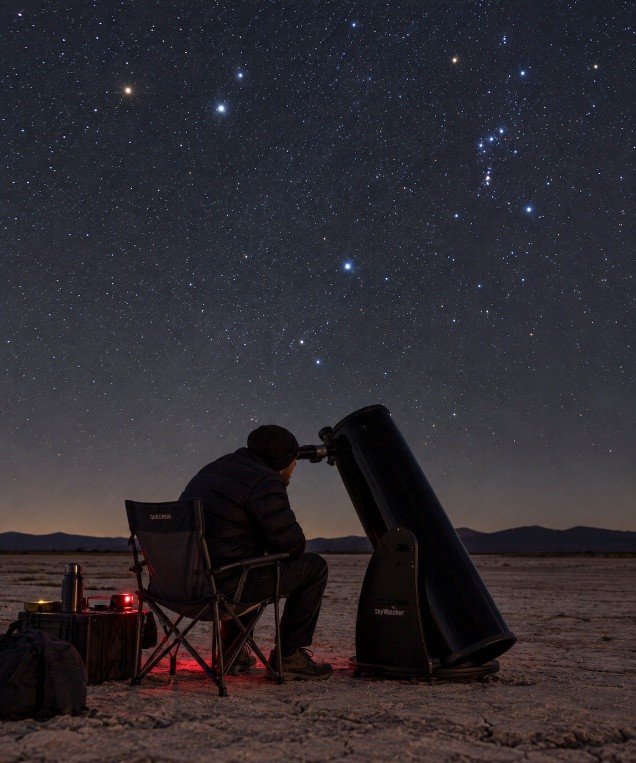
But finding an object with a telescope is not an easy job.
You need to know where an object is located and which constellation it belongs to. At the same time, you need to know which constellations are currently visible in the sky and where they are positioned.
And even after knowing all of this, pointing your telescope exactly at the object is not as straightforward as it sounds.
The sky is enormous, while every celestial object occupies an incredibly tiny portion of it. Finding one is almost like trying to hit a dartboard from a hundred metres away. You simply cannot point your telescope randomly and expect to land on it.
Instead, you first locate a bright, easily identifiable star near your target. From there, you follow a pattern of stars until you eventually reach your desired object, moving from one star to another.
This technique is called star hopping.
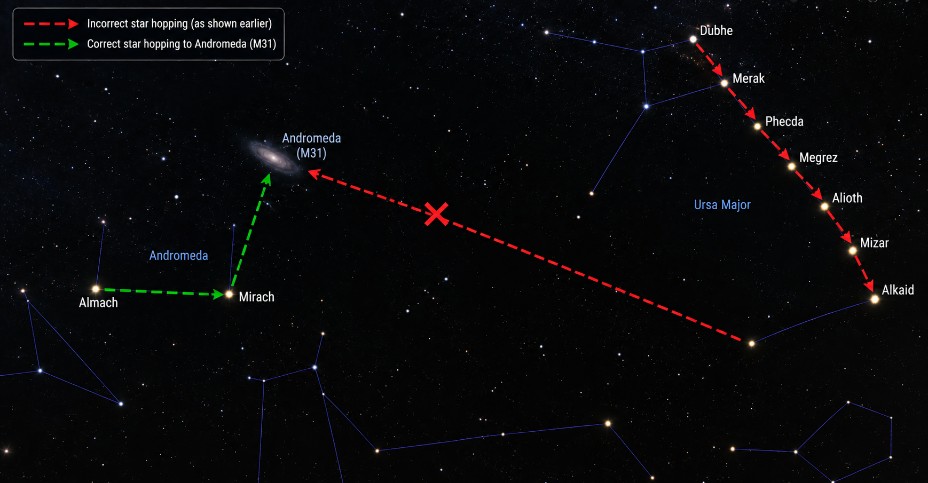
The fun part is that you need to learn the patterns of stars and use them as markers to navigate the sky. Every object has its own little route to find it.
And then comes the moment that makes all the effort worthwhile.
After searching, hopping from star to star, adjusting the telescope and sometimes wondering whether you are even looking in the right place, the object finally appears in your eyepiece.
That feeling is incredible.
You realise that you have just found something that may be hundreds, thousands, or even millions of light-years away—and you are actually looking at it with your own eyes.
It is difficult to put that feeling into words.
It feels almost like solving a puzzle. You spend the entire night finding one celestial object after another, and every successful discovery gives you a small sense of achievement.
Unfortunately, visual observation has taken a bit of a back seat for me lately. There are several challenges, but the biggest one is light pollution.
Under a dark sky, thousands of stars are visible and they become your road map. Under a heavily light-polluted sky, many of those stars simply disappear. Finding your target becomes much more difficult.
And even when you do find it, the background sky can be so bright that the contrast of the object is greatly reduced. Something that would look fascinating under a dark sky can become faint and underwhelming from a city or heavily light-polluted location. Astrophotography, on the other hand, is a completely different experience.
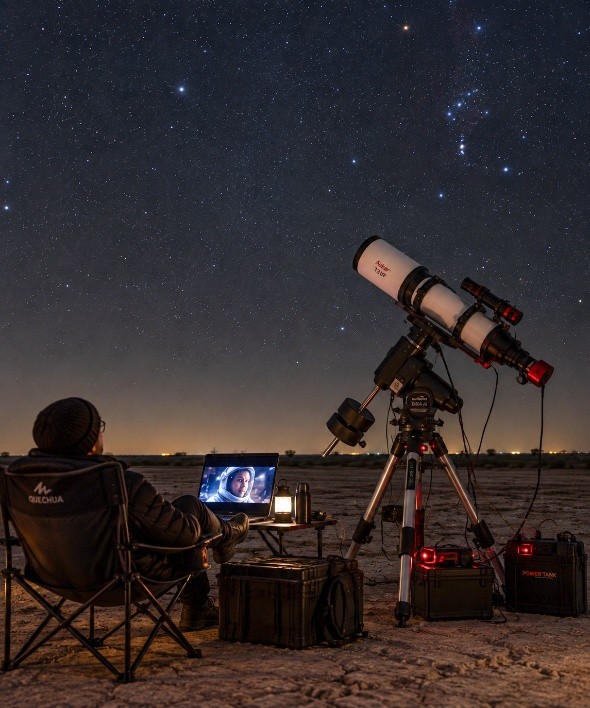
With visual observation, you have different objects to find throughout the night, so there is always something to do. Astrophotography is different. You have to set up your entire system first—and believe me, that is not as easy as it sounds.
Setting up an astrophotography rig requires a lot of attention, patience, focus and, above all, calmness. There are so many things that need to be done correctly before you can finally press that button and let the camera start capturing.
But once everything is set up and the sequence is running, the night suddenly becomes yours.
You have time.
Time to simply sit back and look at the stars.
Time to enjoy a hot beverage.
Sometimes, even time to watch a movie with a bowl of popcorn.
I genuinely enjoy those hours. Every now and then, I check on the equipment to make sure everything is going smoothly. If it is, I go back to my chair and simply enjoy being outside under the stars.
And perhaps that is my favourite part of astrophotography.
It gives you the opportunity to slow down.
There is a sense of tranquillity in spending an entire night beneath the stars that is difficult to experience anywhere else.
The world becomes quiet. The distractions disappear. And for a few hours, it is just you, your telescope, and the universe above you.
I have spent countless nights doing this, and I plan to keep doing it for the rest of my life.

Leave a Reply