
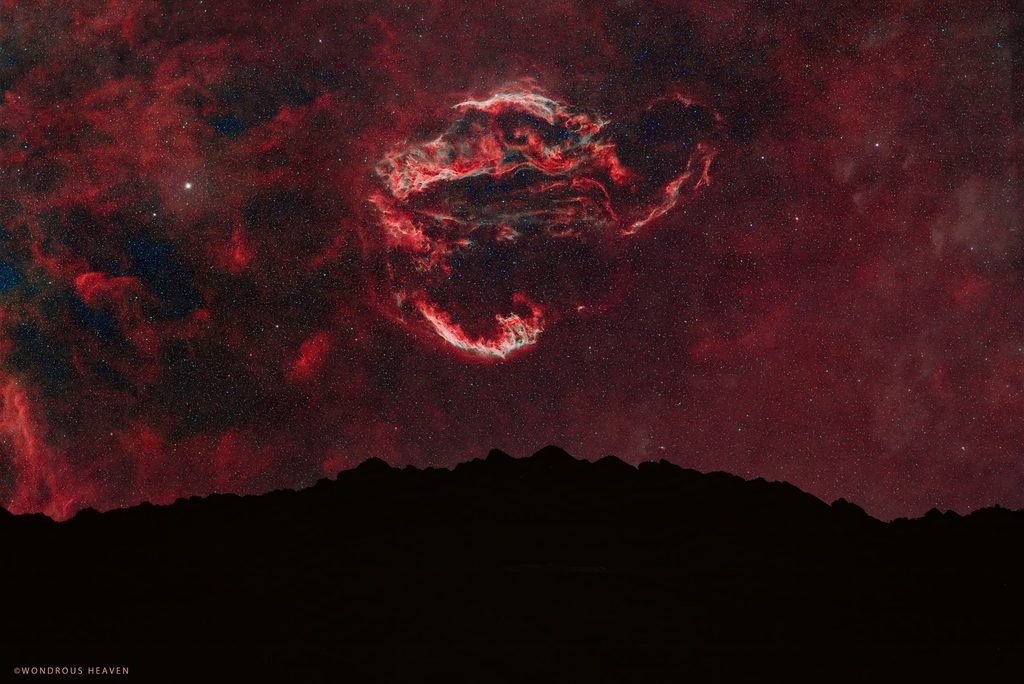
The Veil Nebula is the spectacular remains of a star that exploded around 10,000 years ago. Located about 2,400 light-years from Earth in the constellation Cygnus, it stretches across a part of the sky nearly six times wider than the full Moon. The vibrant red glow comes from hydrogen gas, while the striking teal-blue color comes from oxygen gas, both shining after being energized by the ancient explosion. It’s a beautiful reminder that even the end of a star’s life can create one of the most breathtaking sights in the universe.
OBJECT DETAILS:
Type: Supernova Remnant
Constellation: Cygnus
Magnitude: +5
Size: 3⁰ x 3⁰
Distance: 2400 light years
EQUIPMENT USED
🔭 Rokinon 135mm T2.2 Full Frame Telephoto Cine DS Lens
📷 ZWO ASI2600MC Pro Camera
⚙️Skywatcher Star Adventurer GTi Mount
⚫ Optolong 2″ L-Enhance Filter
🔭 Angel Eyes 50mm Guidescope
📷 ZWO ASI120MM Guide-camera
💻 ASIAIR Plus 256GB
📥 ZWO EOS Filter Drawer
🔭 Leofoto 365C Tripod
CAPTURE DETAILS
⚪ 5 mins × 56 frames
⚫ 15 Darks
⚪ 15 Flats
⚫ 15 Bias
🔊 Gain: 100
🕑 Total integration time: 280 mins
= 4 Hrs 40 Mins total integration
🌡Sensor Temperature: -10 Degrees
🗻 Foreground: 3 Minutes x 1 Frame
📍Location: Mud Village, Himachal Pradesh
⬆️ Altitude: 12500 Feet
🌌 Sky Bortle Scale: 2
✨ SQM: 21.99
🌤 Weather Condition: Clear and Windy
📆 Capture Date: 16/06/2026
SOFTWARE USED
Image Acquisition: ASIAIR
Guiding: ASIAIR
Planetarium: ASIAIR
Polar Alignment: ASIAIR
Mount Control: ASIAIR
Pre-processing: Pixinsight
Post-processing: Pixinsight and Photoshop

Leave a Reply